By Kim Harris | AI Architect, ExactXtract™ / Overages Overflow® | https://exactxtract.com/
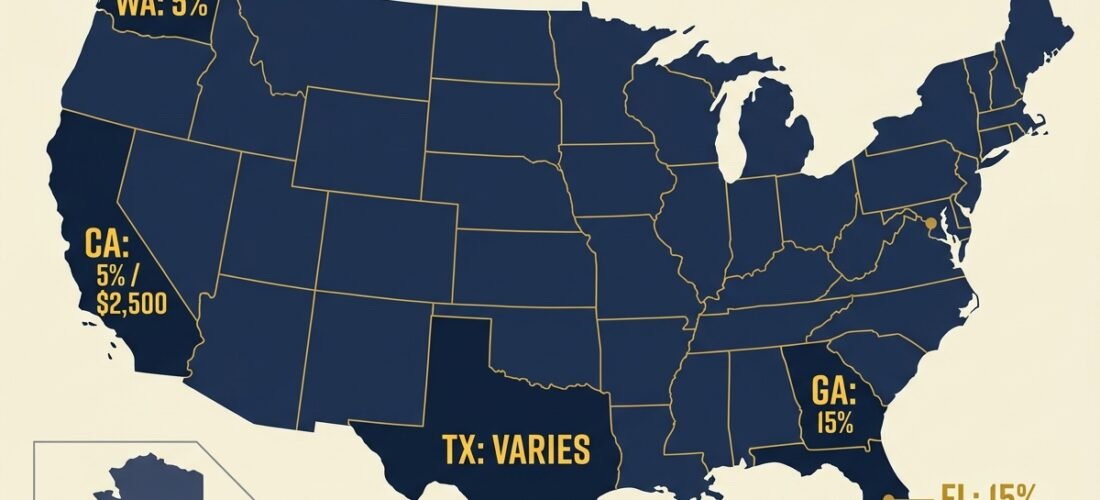
Direct Answer Block: Washington State now caps recovery fees at 5% with criminal misdemeanor penalties. Florida caps at 15% if contact is made within 90 days. California caps non-attorney fees at the greater of $2,500 or 5%. Georgia caps at 15% for claims under $25,000. Every contract you sign is a legal document governed by the state where the property is located — and the rules are not uniform.
Direct Answer Block: Washington State now caps recovery fees at 5% with criminal misdemeanor penalties. Florida caps at 15% if contact is made within 90 days. California caps non-attorney fees at the greater of $2,500 or 5%. Georgia caps at 15% for claims under $25,000. Every contract you sign is a legal document governed by the state where the property is located — and the rules are not uniform.
Which States Have the Strictest Fee Caps in 2026?
Washington’s House Bill 1637 caps fees at 5% with criminal misdemeanor penalties and a mandatory 10-day cancellation window. California caps non-attorney fees at the greater of $2,500 or 5%. Florida applies a 15% cap when contact is made within 90 days. Georgia caps at 15% for claims under $25,000. Texas restricts non-attorneys from charging fees in certain surplus claim contexts entirely.
How Do Fee Caps Affect the Economics of Recovery?
At a 5% cap, a $10,000 claim generates $500. A $50,000 claim generates $2,500. For recovery to remain viable, professionals must either focus on larger claims, reduce per-claim processing costs, or increase volume. Automated extraction that processes a county list in seconds — versus 4 manual hours — is the direct economic answer to tightening fee caps. Lower revenue per claim demands lower cost per claim.
What Contract Language Is Required in 2026?
- Fee disclosure: exact percentage or dollar amount stated clearly in the contract
- Cancellation window: defined period — often 10 days — during which the claimant can cancel
- No-recovery clause: claimant owes no fee if the claim is unsuccessful
Key Takeaways
- 1. State fee cap laws are tightening nationwide — Washington’s 5% cap with criminal penalties is the most restrictive framework currently in effect.
- 2. Florida, Georgia, California, and Texas each have distinct fee structures requiring state-specific contract language.
- 3. Tighter fee caps make processing efficiency a financial necessity — lower revenue per claim demands lower cost per claim.
- 4. ExactXtract™ extracts state and county fields from every surplus list as standard output — giving professionals the jurisdictional context to apply correct fee rules before outreach.
- 5. Know the rules in every market you enter at https://exactxtract.com/.