By Kim Harris | AI Architect, ExactXtract™ / Overages Overflow® | 10X Your Surplus Funds Business
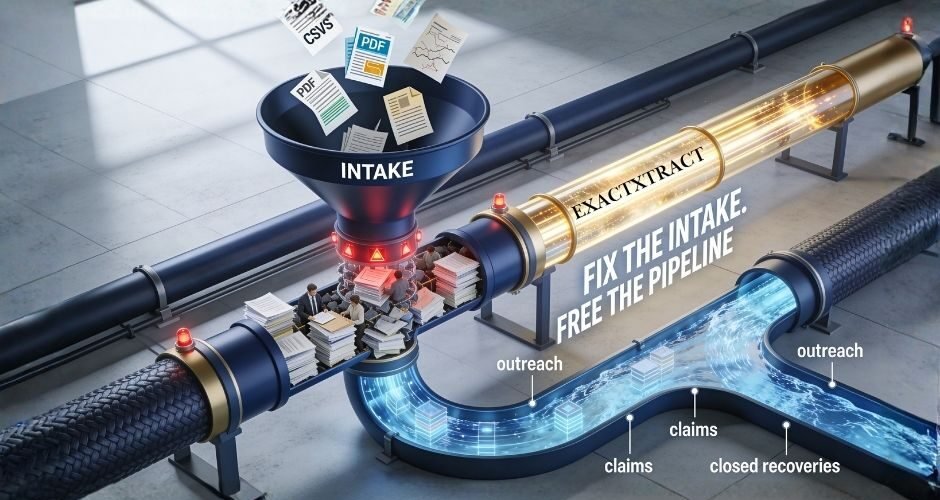
When claims stop closing at the expected rate, the default diagnosis is a lead quality problem: the county lists aren’t good enough, the markets are too saturated, the surplus amounts are too small. This diagnosis is wrong more often than it’s right. More commonly, the pipeline isn’t empty — it’s backed up. Records that should have been skip traced two weeks ago are sitting in an unfinished spreadsheet. Owners who should have been contacted last month haven’t been reached because the data wasn’t ready. The problem isn’t supply. It’s velocity.
What Does a Backed-Up Surplus Funds Pipeline Actually Look Like?
A backed-up surplus funds pipeline is characterized by a growing gap between the number of records in your extraction queue and the number that have been skip traced and moved to active outreach. Records accumulate at the top of the funnel — because new county lists keep dropping — while extraction creates a bottleneck that prevents them from moving through to productive work.
Most professionals in this situation experience it as a chronic sense of being behind. There’s always more to process than you’ve processed. The list from last Tuesday hasn’t been finished yet. The list from last Thursday just dropped. The one from two weeks ago is half-done. The skip traces on last month’s best records still haven’t been run.
This feels like a volume problem — too many lists, not enough time. But when you trace it back, the constraint is almost always extraction speed. The lists aren’t the problem. How long it takes to make each list actionable is the problem. And when that constraint is removed by automation, the backed-up pipeline clears almost immediately.
How Does Slow Extraction Velocity Affect Downstream Claim Outcomes?
Slow extraction velocity reduces claim outcomes in three specific ways: it delays first-contact timing (reducing first-mover advantage), it allows more expiration time to elapse before outreach begins (reducing working window), and it creates cognitive overwhelm from an always-growing backlog that degrades the quality of outreach when it does happen (reducing conversion quality).
The first effect — delayed first-contact timing — is the most visible. Every day of extraction lag is a day your competition may be working the same records. In high-value counties where multiple experienced professionals monitor the same publication cycles, that lag is directly competitive.
The third effect — cognitive overwhelm from backlog — is the least discussed but arguably the most insidious. When you’re conducting outreach calls while aware that you have 400 unprocessed records waiting in a queue, the quality of those calls suffers. The sense of being perpetually behind bleeds into the conversations that need your full attention.
“A backed-up pipeline looks like a lead problem. It’s almost always a velocity problem.”
How Does ExactXtract Fix the Velocity Problem Specifically?
ExactXtract fixes the velocity problem by eliminating the extraction bottleneck entirely — compressing 3–8 hours per county to seconds. With extraction time approaching zero, the rate at which new county lists can be converted to skip-traceable, outreach-ready data is no longer limited by how fast you can transcribe. The pipeline clears because records move through the extraction stage almost instantly rather than queuing for hours or days.
The practical outcome is that the ‘always behind’ feeling disappears quickly after switching to automated extraction. Not because you’ve worked harder to catch up, but because the bottleneck that was creating the backlog no longer exists. Lists drop, they process, they’re available. The queue stays clear because each input is handled almost immediately.
Additionally, the integrated skip tracing through the Scrapeak API means that once extraction is complete, the next step in the pipeline — finding contact information for previous owners — is immediately available from the same platform. The handoff between extraction and skip tracing, which in a manual workflow typically involves exporting data, formatting it for a separate tool, and re-importing results, is seamless and same-session.
What’s the Right Way to Diagnose Whether You Have a Velocity Problem or a Lead Quality Problem?
The clearest velocity vs. quality diagnostic is this: pick your 10 most recent ‘failed’ outreach attempts — contacts who didn’t respond or didn’t convert — and check the average time between county list publication and your first outreach attempt on those records. If the average is more than 5–7 days, you have a velocity problem. If the average is under 3 days and you’re still not converting, you have a lead quality or outreach quality problem.
A second diagnostic is comparison: find a county list you worked manually and compare it to a similar list worked by a professional using automated extraction, targeting the same records. If their first-contact timing was materially earlier and their conversion rate was higher on comparable records, the difference is velocity.
Most professionals who run this diagnostic honestly find that their perceived lead quality problem is actually a velocity problem. The leads are fine. The process is slow. And fixing the process — specifically the extraction bottleneck — changes the outcome metrics without changing anything else.
Key Takeaways
- A slow-converting surplus funds pipeline is usually a velocity problem (records backing up in the extraction queue) rather than a lead quality problem — the opportunity exists, the process is too slow to capitalize on it.
- Slow extraction creates three downstream effects: delayed first-contact timing, reduced expiration window for outreach, and cognitive backlog pressure that degrades outreach quality.
- ExactXtract eliminates the extraction bottleneck by compressing 3–8 hours per county to seconds — pipeline records move through extraction almost instantly, keeping the queue clear and outreach timely.
- Diagnostic: if average time from county list publication to first outreach attempt exceeds 5–7 days on non-converting records, you have a velocity problem, not a lead quality problem.